


Get the latest price? We'll respond as soon as possible(within 12 hours) Fields marked with an asterisk * are required.

Blog
Waste Textile Shredder for Recycling
2026-04-17 17:37:23
The demand for a waste textile shredder for recycling is rapidly increasing as global textile waste continues to grow. With the expansion of the fashion industry and industrial fabric usage, large volumes of discarded textiles are generated every year. Recycling these materials through shredding technology not only reduces environmental pollution but also creates valuable reusable resources.
Sources of Waste Textile
Waste textiles come from various industries and daily life. Understanding their origins helps improve recycling efficiency.
Main sources include:
- Garment manufacturing waste – Offcuts, defective fabrics, and leftover materials
- Post-consumer textiles – Used clothing, old curtains, carpets, and upholstery
- Industrial textiles – Waste from automotive, construction, and filtration industries
- Medical textiles – Disposable gowns, masks, and nonwoven fabrics
These sources provide a consistent supply of raw materials for recycling plants.
Classification of Waste Textile
Waste textiles can be categorized based on material composition and usability:
1. Natural Fibers
- Cotton, wool, silk, and linen
- Biodegradable and easier to recycle
2. Synthetic Fibers
- Polyester, nylon, acrylic
- Durable but require specialized processing
3. Blended Fabrics
- Combination of natural and synthetic fibers
- More complex to recycle due to mixed composition
4. Nonwoven Textiles
- Used in hygiene products and industrial applications
- Lightweight and suitable for shredding into fillers
Waste Textile Shredder Introduction
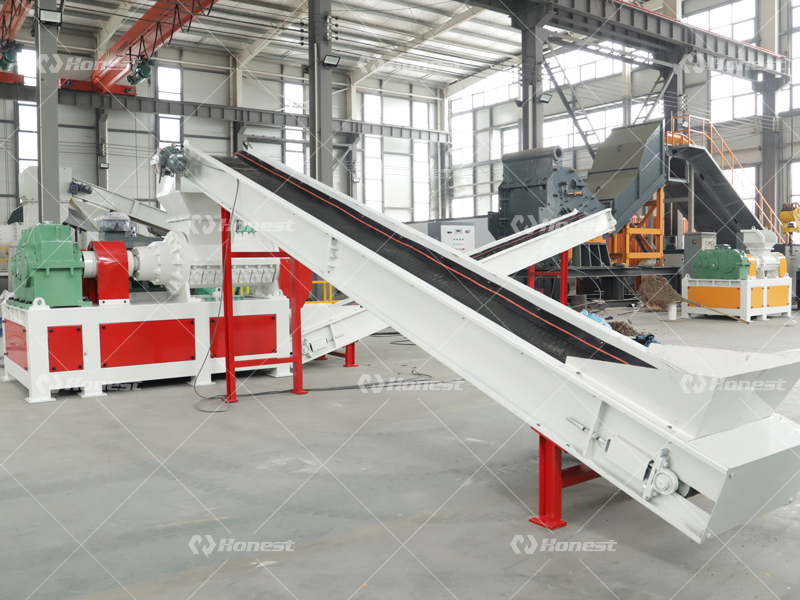
A waste textile shredder for recycling is a specialized machine designed to reduce textile waste into smaller fibers or strips for reuse.
Key features include:
- Strong cutting blades for tough fabrics
- Adjustable output size for different applications
- High automation and continuous feeding system
- Energy-efficient and low-noise operation
These machines are essential in modern textile recycling lines, ensuring consistent and efficient processing.
Working Process of Textile Shredding
The recycling process using a textile shredder involves several steps:
- Feeding
Waste textiles are fed into the shredder manually or via conveyor systems - Shredding
Rotating blades cut materials into small pieces or fibers - Separation (Optional)
Metal components like zippers or buttons are removed using magnetic separators - Collection
Shredded materials are collected and stored for further processing
This streamlined process ensures high productivity and minimal material loss.
Applications of Shredded Textile Output
After shredding, textile waste can be reused in various industries, increasing its economic value.
Main application fields include:
- Insulation materials – Used in construction and automotive industries
- Filling materials – For furniture, cushions, and mattresses
- Recycled yarn production – Spun into new textile products
- Nonwoven fabric manufacturing – Used in geotextiles and industrial fabrics
- Fuel alternatives (RDF) – Used as refuse-derived fuel in energy plants
Economic and Environmental Benefits
Using a waste textile shredder for recycling offers multiple advantages:
- Reduces landfill waste and environmental pollution
- Saves raw material costs by reusing fibers
- Creates new revenue streams from recycled products
- Supports sustainable and circular economy practices
A waste textile shredder is a vital solution for managing increasing textile waste. By understanding waste sources, classifications, and processing methods, businesses can effectively convert discarded textiles into valuable materials. With growing environmental awareness and market demand, textile recycling is becoming a profitable and sustainable industry worldwide.