


Get the latest price? We'll respond as soon as possible(within 12 hours) Fields marked with an asterisk * are required.

Blog
Spiral Plastic Waste Grinder
2026-06-10 18:12:44
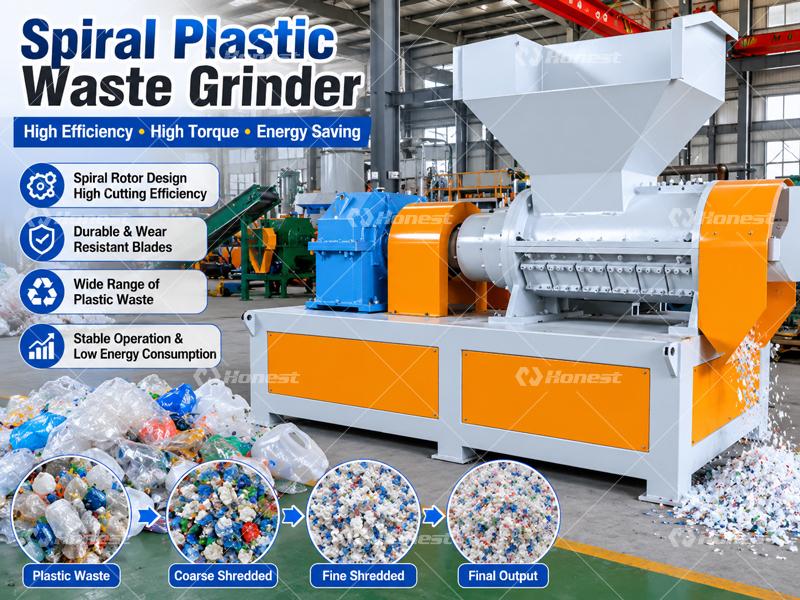
The growing global demand for sustainable waste management has made spiral plastic waste grinder a vital component in recycling operations. Designed for high-efficiency processing, these machines can handle diverse plastic materials, including polyethylene (PE), polypropylene (PP), polystyrene (PS), and PVC, converting waste into reusable pellets or granules. Businesses seeking to reduce environmental impact and generate revenue from plastic waste can benefit from installing a spiral plastic waste grinder in their facility.
Key Applications
Spiral plastic waste grinders are widely used in:
- Industrial Plastic Recycling Plants – To process production scraps and defective products.
- Post-Consumer Waste Recycling – For grinding household plastics, packaging materials, and containers.
- Plastic Pellet Production – Prepares uniform feedstock for extrusion and molding processes.
- Agricultural Applications – Grinding plastic mulch films, irrigation pipes, and greenhouse sheets.
- Construction Waste Recycling – Reduces plastic sheets, pipes, and protective films into reusable granules.
These versatile applications make the spiral plastic waste grinder an essential tool in both small-scale and industrial recycling projects.
Features and Advantages
A modern spiral plastic waste grinder offers numerous benefits:
- High Efficiency and Throughput – The spiral design ensures continuous feeding and uniform grinding, significantly increasing processing speed.
- Durable Construction – Manufactured using high-grade steel and wear-resistant blades, suitable for tough plastics.
- Energy Efficiency – Spiral design reduces motor load and power consumption compared to conventional grinders.
- Adjustable Granule Size – Screen plates and spiral rotation speed allow control over the final particle size.
- Low Noise and Dust Emission – Incorporates noise-dampening and dust collection systems, ensuring compliance with environmental standards.
- Easy Maintenance – Spiral rotor and blades are designed for easy replacement and minimal downtime.
- Safety Features – Emergency stop systems, overload protection, and interlocks ensure safe operation.
These features contribute to long-term operational efficiency, low maintenance costs, and high-quality recycled material output.
Technical Specifications
Typical specifications of a spiral plastic waste grinder include:
- Motor Power: 15–75 kW, depending on capacity
- Capacity: 200–1000 kg/h
- Rotor Speed: 200–400 RPM
- Screen Size: 5–20 mm adjustable
- Spiral Design: Multi-layer spiral feeding for continuous operation
- Voltage: 380V/50Hz or customized
Such technical flexibility allows the machine to accommodate different types of plastics and production scales, from small workshops to large industrial plants.
Economic Benefits
Investing in a spiral plastic waste grinder offers tangible returns:
- Reduced Waste Disposal Costs – Converts plastic waste into valuable raw materials.
- Revenue from Recycled Products – Ground plastics can be sold or reused in manufacturing.
- Long Lifespan and Low Maintenance – Reduces replacement frequency and labor costs.
- Energy Savings – Spiral feeding design lowers electricity usage, reducing operational expenses.
Businesses typically experience a payback period of 1–3 years, depending on production scale, plastic types processed, and market conditions.
Installation and Operation Tips
- Proper Feeding – Ensure plastics are sorted and free of metal contaminants to prevent blade damage.
- Routine Maintenance – Regularly check rotor blades, screen plates, and motor bearings.
- Dust Control – Use a connected dust extraction system to maintain clean and safe work conditions.
- Adjustments – Calibrate spiral speed and screen size for optimal granule size based on downstream processing requirements.
Following these practices enhances machine performance and ensures consistent output quality.
Spiral plastic waste grinder is an indispensable tool for modern plastic recycling operations. Its unique spiral feeding system, high efficiency, adjustable granule output, and durable design make it ideal for handling diverse plastic wastes. By incorporating this machine into recycling facilities, businesses can achieve significant environmental benefits, reduce disposal costs, and generate revenue from recovered plastics. With proper installation, maintenance, and operation, the spiral plastic waste grinder delivers both sustainability and profitability, making it a key asset for the circular economy.