


Get the latest price? We'll respond as soon as possible(within 12 hours) Fields marked with an asterisk * are required.

Blog
Heavy Duty Industrial Shredder
2026-03-06 14:51:55
In modern recycling and waste management industries, the heavy duty industrial shredder plays a crucial role in processing large volumes of tough materials. Designed for high strength and continuous operation, this powerful machine can shred various types of industrial waste into smaller pieces for easier recycling, transportation, and further processing. Due to its durability and efficiency, heavy duty industrial shredders are widely used in recycling plants, manufacturing facilities, and waste treatment centers.
1. Materials Suitable for Heavy Duty Industrial Shredders
Heavy duty industrial shredder is designed to handle a wide range of hard and bulky materials. Its strong cutting system and high torque make it suitable for processing difficult materials that ordinary shredders cannot handle.
Common materials include:
-
Scrap metal such as steel sheets, aluminum parts, and metal containers
-
Plastic waste including plastic drums, plastic pipes, and plastic pallets
-
Electronic waste like computer shells, appliances, and electronic components
-
Rubber products such as used tires and rubber blocks
-
Wood waste including wooden pallets, furniture, and construction wood
-
Industrial solid waste generated from factories and production lines
By shredding these materials, the machine helps reduce waste volume and improves recycling efficiency.
2. Types of Heavy Duty Industrial Shredders
There are several types of heavy duty industrial shredders, each designed for different materials and processing requirements.
Single-Shaft Shredder
This type uses one rotating shaft equipped with cutting blades. It is commonly used for plastics, wood, and industrial waste.
Double-Shaft Shredder
A double-shaft shredder has two rotating shafts that tear materials from both sides. It is suitable for metal scraps, tires, and bulky materials.
Four-Shaft Shredder
This machine has four cutting shafts, providing stronger crushing ability and more uniform output size.
Hammer Metal Shredder
This type uses high-speed rotating hammers to crush metal materials such as aluminum cans and scrap steel.
Each type offers specific advantages depending on the application and material type.
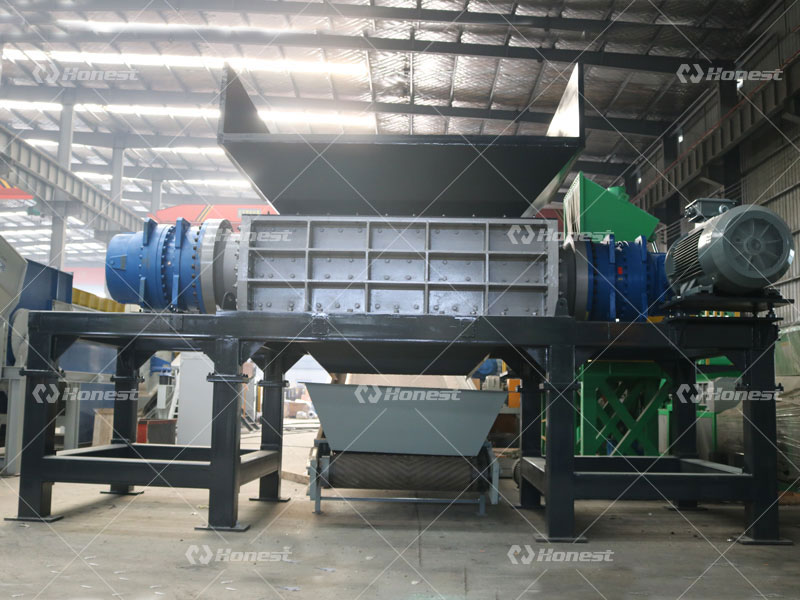
3. Structure of a Heavy Duty Industrial Shredder
A typical heavy duty industrial shredder is built with a robust structure to ensure durability and stable operation. Its main components include:
-
Feeding hopper for loading materials
-
High-strength shredding blades made from alloy steel
-
Rotating shafts that drive the cutting blades
-
Power system, usually electric motors or hydraulic drives
-
Gearbox for torque transmission
-
Control system for operation and safety monitoring
-
Discharge system for releasing shredded materials
The heavy-duty frame and reinforced components allow the machine to handle continuous industrial workloads.
4. Working Process of the Machine
The working process of a heavy duty industrial shredder involves several steps that ensure efficient material reduction.
-
Material Feeding
Waste materials are loaded into the feeding hopper using conveyors or loaders. -
Cutting and Tearing
Rotating blades or shafts grip the materials and tear them into smaller pieces through powerful shearing forces. -
Crushing and Size Reduction
The materials are repeatedly cut and compressed until they reach the required size. -
Discharge
The shredded materials are released through the discharge outlet and can be sent to further processing systems.
This process significantly reduces the size and volume of bulky waste materials.
5. Final Condition of Shredded Materials
After processing in a heavy duty industrial shredder, materials become smaller, more uniform fragments. This provides several benefits:
-
Reduced storage and transportation costs
-
Improved efficiency for sorting and recycling
-
Better preparation for smelting or reprocessing
-
More stable material flow for downstream equipment
For example, shredded metal can be easily melted in furnaces, while shredded plastic and rubber can be reused in manufacturing processes.
The heavy duty industrial shredder is an essential machine for modern recycling and waste management industries. With its ability to process a wide range of tough materials, strong structural design, and efficient shredding process, it significantly improves material handling and recycling efficiency. As global industries continue to focus on sustainability and resource recovery, heavy duty industrial shredders will remain a key technology for large-scale waste processing and recycling operations.