


Get the latest price? We'll respond as soon as possible(within 12 hours) Fields marked with an asterisk * are required.

Blog
Tire Shredding System
2026-01-05 16:55:57
Tire shredding system is an integrated recycling solution designed to process waste tires into smaller rubber pieces for further reuse. It is widely used in tire recycling plants, waste management facilities, and resource recovery projects.
By reducing whole tires into shreds, chips, or rubber granules, a tire shredding system makes tire waste easier to transport, store, and reprocess. It plays a vital role in converting discarded tires into valuable raw materials, supporting sustainable recycling and environmental protection.
2. Working Process of a Tire Shredding System
The working process of a tire shredding system begins with feeding waste tires into the primary shredder. The shredder uses high-torque cutting shafts or rotating blades to tear the tires into rough strips.
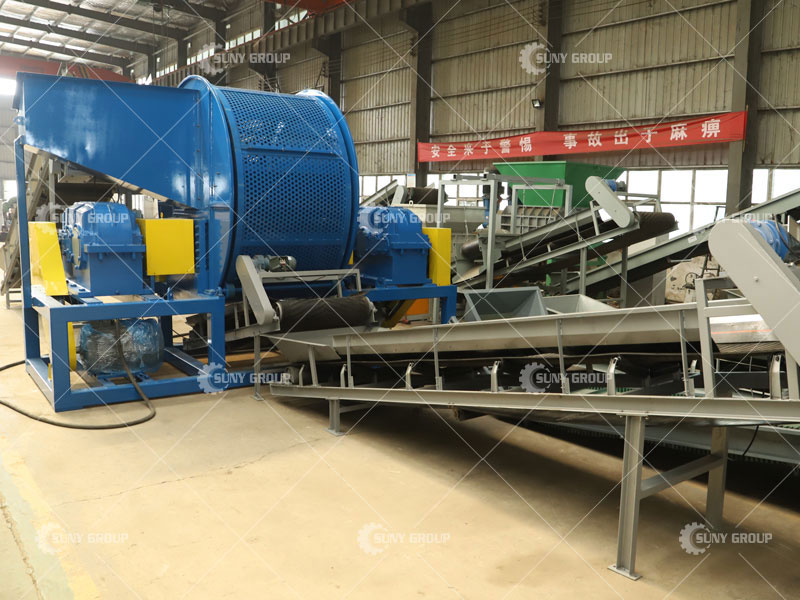
After primary shredding, the material is transferred to secondary shredders or granulators, where tire pieces are further reduced to uniform sizes. Steel wires embedded in the tires are released during this stage.
Magnetic separators are then applied to remove steel components, while vibrating screens control output size. Advanced tire shredding systems may also include fiber separation units and dust collection systems, ensuring clean rubber output and stable plant operation.
3. Main Components of a Tire Shredding System
A complete tire shredding system consists of several key components working together efficiently. The core equipment includes primary shredders, secondary shredders, and rubber granulators. These machines are designed with wear-resistant blades and reinforced frames to handle tough tire materials.
Additional components include conveyor belts, magnetic separators, vibrating screens, and intelligent control cabinets. Each component is precisely coordinated to ensure smooth material flow and consistent output quality.
Modern tire shredding systems are often equipped with automatic control systems, overload protection, and energy-saving motors, which enhance operational safety and reduce maintenance requirements.
4. Advantages of a Tire Shredding System
Using a tire shredding system offers multiple advantages for recycling operations. First, it improves processing efficiency by enabling continuous, large-capacity tire treatment.
Second, the system enhances material recovery by effectively separating rubber, steel, and fibers. High-quality rubber output can be used in applications such as rubber mats, playground surfaces, asphalt modification, and molded rubber products.
Third, tire shredding systems are designed for stable performance and long service life, even under demanding operating conditions. Their modular design allows flexible configuration based on production capacity and output size requirements.
Finally, by reducing tire waste and promoting material reuse, a tire shredding system helps recycling plants comply with environmental regulations and achieve sustainable development goals.
Tire shredding system is a reliable and efficient solution for waste tire recycling, delivering consistent output quality and strong economic returns. It is an essential investment for modern tire recycling facilities.