


Get the latest price? We'll respond as soon as possible(within 12 hours) Fields marked with an asterisk * are required.

Blog
Textile Recycling Machine
2025-12-02 11:14:52
Textile recycling machine is an essential solution for managing the increasing volume of post-consumer and industrial fabric waste. As global apparel consumption grows, effective textile processing and material recovery become critical for environmental protection. Understanding textile categories, recycling methods, specialized machinery, and the applications of recycled fibers helps companies build efficient and sustainable recycling systems.
1. Main Types of Textiles
Textiles come from diverse raw materials and structures. They can be categorized as follows:
1.Natural Fibers
– Cotton, wool, silk, hemp.
– Common in clothing, home fabrics, and upholstery.
2.Synthetic Fibers
– Polyester, nylon, acrylic, spandex.
– Widely used due to durability and elasticity.
3.Blended Fabrics
– Cotton–polyester, wool–acrylic, nylon–spandex.
– Require specialized recycling machines because multiple materials are combined.
4.Industrial Textiles
– Non-woven fabrics, geotextiles, automotive interior materials.
5.Household Textiles
– Curtains, carpets, bedding, towels, sofa covers.
Knowing textile composition is essential for choosing the appropriate recycling process and machinery.
2. How Waste Textiles Are Processed
The textile recycling process includes several key steps designed to convert fabric waste into usable fiber forms.
◊Collection and Sorting
– Items are separated by fiber type, color, and contamination level.
– Automated sorting systems help improve efficiency.
◊Pre-Processing
– Removing zippers, buttons, hard plastics, and metal accessories.
– Cutting large materials into smaller sizes for uniform feeding.
◊Fiber Opening and Cleaning
– Breaking down textile waste into loose fibers using tearing and opening machines.
– Removing dust, impurities, and remaining contaminants.
◊Fiber Refining
– Multiple opening, carding, and blending processes create uniform recycled fibers.
-
Baling and Packaging
– Finished fibers are pressed into bales for transport and further manufacturing.
3. Main Types of Textile Recycling Machines
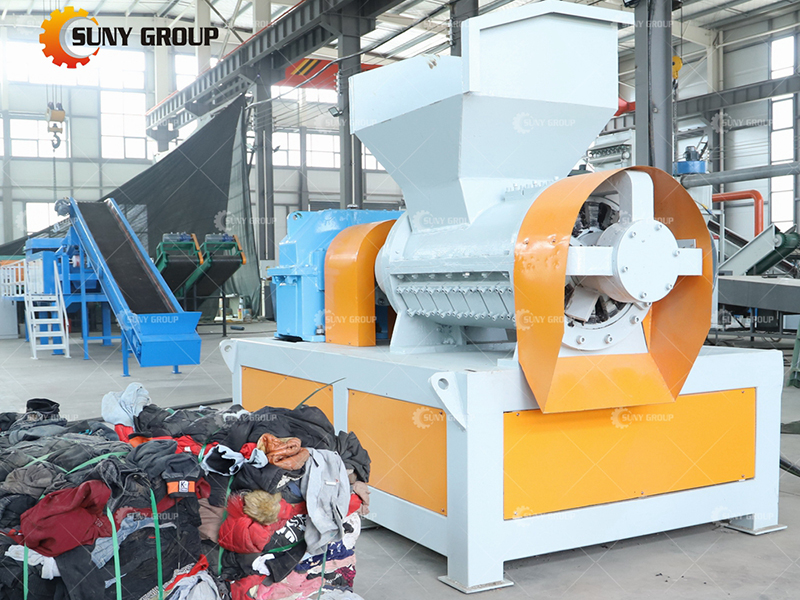
A textile recycling machine line usually includes several specialized units:
♦Textile Shredder
– Cuts fabrics into small, consistent strips for easy processing.
♦Fiber Opening Machine
– Opens and loosens fiber bundles to prepare them for further tearing.
♦Textile Tearing Machine
– The core of the recycling line; converts waste fabric into reusable fibers.
♦Dust Removal System
– Eliminates dust and light impurities during the tearing process.
♦Conveyor and Feeding Systems
– Ensures continuous production and stable operation.
♦Fiber Compactor or Baling Machine
– Compresses recycled fibers into bales for storage and shipping.
These machines work together to create a complete textile recycling solution suitable for clothing factories, waste processing companies, and renewable material plants.
4. Applications of Recycled Textile Fibers
Recycled fibers obtained from textile recycling machines are widely used across multiple industries.
1.Automotive Industry
– Car insulation materials
– Trunk liners and sound-absorbing mats
2.Home Textile Products
– Mattress filling
– Cushions, pillows, quilts
3.Non-Woven Products
– Felt, geotextiles, carpet underlay
4.Industrial Applications
– Construction insulation
– Protective padding materials
5.Recycled Yarn and Fabric Production
– Some high-quality fibers can be re-spun into yarn for new textile manufacturing.
A textile recycling machine plays a crucial role in reducing waste, recovering valuable fibers, and supporting sustainable manufacturing. By understanding textile types, recycling processes, and the applications of recycled materials, companies can improve resource efficiency and create environmentally responsible production lines. This technology offers long-term environmental and economic benefits for factories, recyclers, and global textile industries.