


Get the latest price? We'll respond as soon as possible(within 12 hours) Fields marked with an asterisk * are required.

Blog
Shredder Machine for PCB Board
2025-11-11 15:25:35
Waste PCB boards, or printed circuit boards, mainly come from discarded electronic devices such as computers, mobile phones, televisions, and home appliances. With global electronic consumption increasing rapidly, the amount of waste PCB boards is growing each year. These boards contain valuable metals and reusable materials, making PCB recycling a profitable and eco-friendly business opportunity.
1. Sources of Waste PCB Boards
-
Consumer electronics: old computers, laptops, and mobile phones.
-
Industrial equipment: outdated control systems and machinery.
-
Home appliances: televisions, washing machines, and air conditioners.
-
Communication devices: routers, modems, and other circuit-based tools.
These sources generate large amounts of PCB waste containing copper, gold, and silver, which have significant recycling value.
2. Profit Potential from PCB Recycling
Processing waste PCB boards brings both economic and environmental benefits:
-
High metal recovery rate: valuable metals like copper, gold, and silver can be extracted and reused.
-
Market demand: recovered metals are widely used in electronics, metallurgy, and industrial manufacturing.
-
Low raw material cost: e-waste is inexpensive to collect compared with newly mined metals.
-
Sustainability: recycling reduces landfill waste and pollution, enhancing a company’s green image.
3. Choosing the Right Shredder Machine for PCB Board
When selecting a shredder machine for PCB recycling, several key factors should be considered:
-
Blade strength: high-hardness alloy blades ensure clean cutting of rigid PCB boards.
-
Motor power: strong torque for consistent shredding performance.
-
Output capacity: depends on production scale, usually ranging from 300 to 2000 kg/h.
-
Dust and noise control: advanced filtration and soundproof design for safe operation.
-
Durability: stable structure and anti-wear components for long service life.
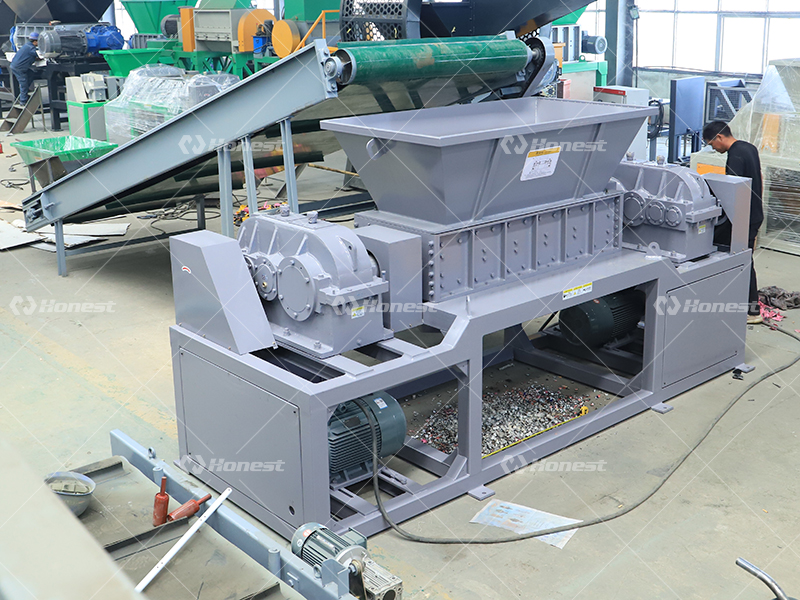
High-quality PCB shredders—such as double-shaft or four-shaft models—offer superior efficiency and precise size reduction, preparing the material for downstream separation.
4. Working Process of PCB Board Shredding
1.Feeding: Waste PCB boards are fed into the shredder.
2.Shredding: Rotating blades tear the boards into small pieces.
3.Separation: Air separation, magnetic separation, and electrostatic systems extract metals from nonmetals.
4.Collection: Recovered copper, aluminum, and precious metals are collected for reuse or sale.
5. Processed Materials and Economic Value
After shredding and separating:
-
Metal powders and particles are sold to metal refining plants.
-
Nonmetal materials like resin and fiberglass are used in construction or as fillers.
-
Recovered copper offers high resale value and demand in electrical manufacturing.
This process transforms waste into marketable resources, achieving high returns with low input costs.
The shredder machine for PCB board is an essential device for efficient, profitable, and eco-friendly e-waste recycling. It helps recover valuable metals, reduce environmental impact, and create sustainable business growth. Investing in a reliable PCB shredding system ensures long-term economic gain and resource efficiency.