


Get the latest price? We'll respond as soon as possible(within 12 hours) Fields marked with an asterisk * are required.

Blog
Hammer Crusher in the Recycling Industry
2025-11-24 12:06:14
Hammer crusher, also known as a hammer mill, has become a key piece of equipment in the modern recycling industry. As global waste volumes rise and resource recovery becomes more urgent, recycling plants increasingly rely on hammer crushers to process waste materials efficiently. Their ability to break down complex, mixed, and contaminated waste makes them ideal for metal recycling, e-waste disposal, construction waste processing, and battery recycling. This article explains the main applications, the structural features of hammer crushers used in recycling, the working principle, and the advantages they offer for various recyclable materials.
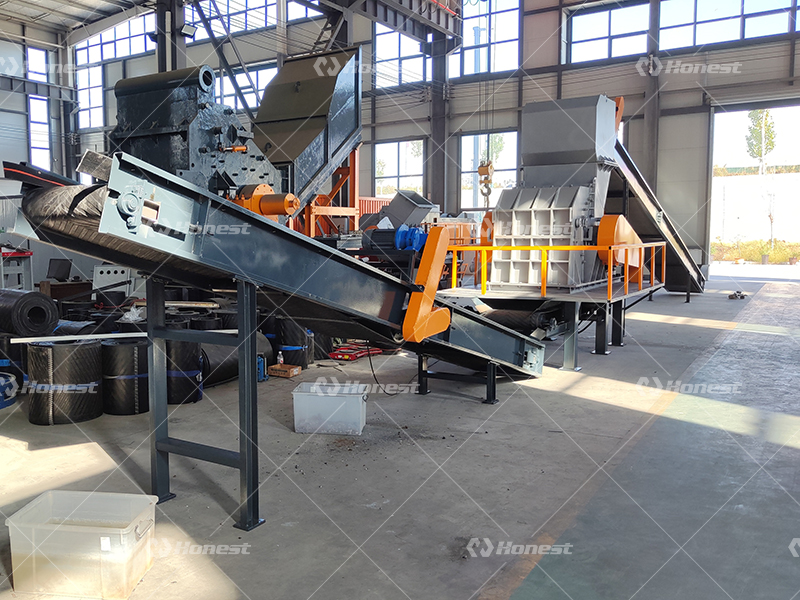
1.Applications of Hammer Crushers in the Recycling Industry
In the metal recycling field, hammer crushers are used to process aluminum scraps, steel offcuts, radiators, metal cans, and light metals. Their high-speed impact force is effective for reducing bulky metal waste into manageable sizes for separation and smelting.
In e-waste recycling, hammer crushers help break down circuit boards, small appliances, and electronic housings, enabling downstream separation of copper, plastics, and precious metals.
In construction and demolition recycling, the machine is applied to crush bricks, concrete blocks, asphalt, and gypsum boards, converting them into reusable aggregates. Hammer crushers are also used in battery recycling lines, especially for spent lithium batteries and lead-acid batteries, where controlled impact force helps open battery shells for further material extraction.
These wide-ranging applications demonstrate the hammer crusher’s significance in improving recycling efficiency and resource recovery.
2.Structure of Hammer Crushers for Recycling Applications
Hammer crushers built for the recycling industry feature a reinforced structure designed to withstand high impact loads and abrasive waste materials. The main components include a heavy-duty frame that stabilizes the machine during continuous operation. The rotor assembly is equipped with wear-resistant hammers made from high-manganese steel or alloy materials, ensuring long service life when handling metal-rich waste.
A large feed hopper accepts oversized or irregular waste, while the crushing chamber is designed with replaceable liners to resist abrasion from metal or mineral contaminants. The grate screen system controls discharge size according to recycling requirements, while the drive motor and transmission unit provide consistent power.
These structural elements allow the hammer crusher to operate reliably in demanding recycling environments while maintaining high throughput.
3.Working Principle of Hammer Crusher in Recycling Processes
The working principle of a hammer crusher in recycling applications is based on dynamic impact. When the motor drives the rotor to rotate at high speed, the hammers generate strong centrifugal force. As recyclable waste enters the crushing chamber, it is rapidly struck by the moving hammers, causing fragmentation through impact, shear, and collision.
Metal components are flattened or broken, electronic parts are shattered for downstream separation, and brittle construction materials are reduced to small particles.
The crushed material passes through the adjustable grate screen, ensuring that only appropriately sized output is discharged. Oversized materials remain in the chamber for continuous impact until they reach the target size. This principle ensures consistent and efficient material reduction, even for mixed or contaminated waste streams.
4.Advantages of Hammer Crushers for Recyclable Materials
Hammer crushers offer several advantages when processing complex recyclable materials. They provide high crushing efficiency, enabling rapid size reduction in a single stage. Their strong adaptability allows them to handle metal, plastic, mineral components, and composite materials without clogging.
The machine delivers uniform output, improving the accuracy of magnetic, eddy-current, or density separation systems in recycling lines. The robust structure ensures long service life, while the simple design makes maintenance straightforward. Hammer crushers can also process moist or dusty waste, maintaining steady operation even under harsh conditions.
Overall, the hammer crusher enhances recycling productivity, reduces operational costs, and improves material recovery rates.